To collect every province by motorcycle, split the Philippines into its regions, clear one region per trip, and use RoRo ferries to jump between islands. Motorcycle touring in the Philippines this way turns 82 provinces into a series of weekend rides and longer loops across Luzon, Visayas and Mindanao, logged one region at a time.
Quick facts
- The Philippines has 82 provinces grouped into 18 administrative regions, counting the Negros Island Region re-created in 2024.
- Luzon is the only island group you can cover almost entirely on roads; Visayas and Mindanao need RoRo ferry crossings.
- RoRo shipping lines typically ask for your motorcycle's OR/CR at the port, so carry originals and photocopies.
- Riders are generally not allowed to stay on their bikes in the cargo deck during a crossing.
- PAGASA issues the official weather and typhoon bulletins that decide whether ferries sail.
How do you ride all provinces in the Philippines?
Treat it as a region-by-region project, not one giant trip. A province count is easy to lose track of; a region is a clear unit you can plan, ride and close out.
A practical order for most riders based in Metro Manila:
- Start with Luzon regions you can reach on a weekend ride. CALABARZON and Central Luzon are the natural warm-ups, with plenty of rides near Manila.
- Take on the northern loops next. Ilocos, the Cordillera and Cagayan Valley reward multi-day trips and mountain roads.
- Head south through Bicol. The Bicol provinces set you up for the ferry jump into the Visayas.
- Island-hop the Visayas. Use RoRo links to string Samar, Leyte, Cebu, Bohol, Negros and Panay together.
- Finish in Mindanao. Plan Mindanao as its own expedition, or ship across and ride it in stages.
Island provinces such as Batanes, Palawan, the Romblon group, Marinduque, the Sulu archipelago and the provinces off Mindanao need their own ferry planning. Many riders leave them for last and handle them as separate trips.
How should you plan motorcycle touring in the Philippines region by region?
Plan each region as its own mini expedition with a short list of anchor stops per province. A stop in every province gives each day a purpose and makes it obvious when a region is done.
Luzon: long loops on land
Northern Luzon is where most riders build their first multi-day tour. In Ilocos, the coastal road up to Patapat Viaduct in Ilocos Norte is a classic turnaround point. From there, cut inland to the Cordillera, where the Halsema Highway highest point marks the climb between Benguet and Mountain Province. Cordillera roads are steep and weather changes fast, so budget extra daylight and check road advisories before leaving Baguio.
Visayas: stitching islands with ferries
The Visayas is a puzzle of short and long sea crossings. Cebu and Bohol pair well on one trip: ride the mountain roads of southern Cebu to Osmeña Peak in Dalaguete, then cross to Bohol for the Chocolate Hills viewpoint. Negros and Panay make a second natural pair. With the Negros Island Region now separate from Central Visayas and Western Visayas, check which region each island falls under when you plan your stamps.
Mindanao: the long game
Mindanao covers six regions, including BARMM, and rewards patient pacing. In Davao, Cape San Agustin in Davao Oriental is a strong anchor for an eastern coast loop. Before riding any Mindanao province, check current travel advisories from official government sources and local authorities, and ride in daylight.
Browse more stops by region on the Waypoint destinations map when you build each region's list.
How do motorcycle RoRo ferries work in the Philippines?
You ride to the port, process your bike at the shipping line's office, pay the vehicle fare and ride on board when called. The details differ by line and port, but the flow is usually the same:
- Arrive early. Queues build at busy ports on long weekends and holidays.
- Prepare your papers. Have OR/CR originals and photocopies plus your driver's license ready at the ticketing office.
- Book ahead where you can. Some lines take online bookings, which helps groups sail on the same trip.
- Secure the bike. Leave it in gear, follow the crew's tie-down instructions, and bring a cover for spray on rough crossings.
- Leave the cargo deck. Take valuables and stay in the passenger area until docking.
Crossings get cancelled when weather turns. Follow PAGASA bulletins and the Philippine Coast Guard's sea travel advisories, and build a spare day into any trip that depends on a ferry.
What documents should you bring on a long ride?
Carry everything you would need at a checkpoint, a port and a repair shop. A simple checklist:
- Driver's license with the correct restriction for your bike
- OR/CR originals, plus several photocopies for ports
- A valid government ID
- Proof of ownership papers or an authorization letter if the bike isn't registered to you
- Emergency contact details and any medical information
For current licensing and registration rules, check the LTO directly. In an emergency, call 911.
How fast should you pace a province-by-province ride?
Slower than you think. Riding fatigue builds over consecutive days, and the goal is to arrive at every province, not to set records.
- Cap your riding day and aim to reach your stop before dark.
- Add rest days every few days on long expeditions, especially after mountain roads.
- Group provinces by season. Save typhoon-exposed eastern seaboards and mountain passes for the drier months. Our rainy season motorcycle riding tips cover what to adjust when you can't wait.
- Service before each region. A long ride exposes worn tires, chains and brake pads fast.
Fuel stops are sparse on some mountain and coastal stretches, so fill up when you can. See this week's pump prices.
How do you keep track of which regions you've completed?
Log each ride so your progress builds automatically instead of living in a notebook. In the Waypoint Passport, you earn a stamp for each Philippine region you ride through, recorded from your GPS-tracked rides.
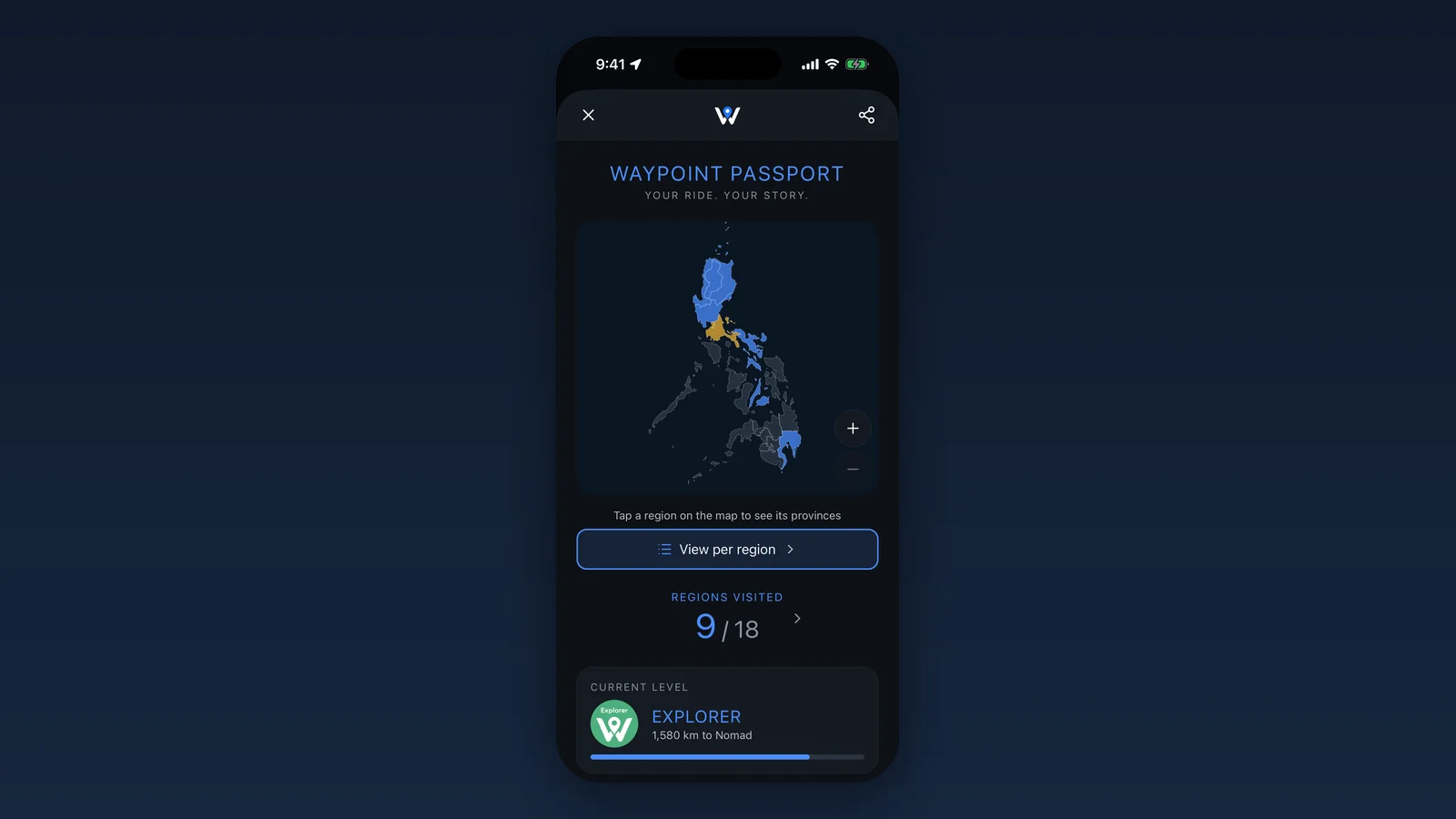
The Passport map shows your progress per region, and a region turns gold once it's complete, so you can see at a glance which parts of Luzon, Visayas and Mindanao still need a trip. Start a Just Ride session at the beginning of each riding day and the ride is saved to your bike's history with distance and time. At each anchor stop, mark it "Been here" and leave a postcard with a photo and a note. Keep your own province checklist alongside it, since the Passport counts regions.
Where should your first region be?
Pick the region closest to home and finish it completely before moving on. Closing out one region builds the habits you'll need for the rest: packing light, carrying your papers, reading weather and pacing your days.
Motorcycle touring in the Philippines at the province level is a project measured in years, and that's the point. Ride safe, keep your documents in order, respect ferry and weather advisories, and let each finished region pull you toward the next island group.