Motorcycle gas cost computation takes one formula: divide your ride's total distance by your bike's real fuel economy in km/L to get liters, then multiply the liters by the pump price per liter. The hard part is using your bike's actual km/L instead of the brochure number, and adding a buffer for traffic, hills and wrong turns.
Quick facts
- Formula: distance (km) ÷ fuel economy (km/L) × pump price per liter = fuel cost.
- Best data source: your own full-tank-to-full-tank test, not the spec sheet.
- Buffer to add: 10 to 20 percent for mountain roads, heavy traffic, a passenger or luggage.
- Works for: any bike, from a 110cc scooter to a big bike, on any ride in Luzon, Visayas or Mindanao.
- What to bring: a phone or notebook to log odometer readings and liters at every fill-up.
How do you compute gas cost for a motorcycle ride?
You compute it in three steps: get the round-trip distance, convert it to liters using your km/L, then multiply by the price per liter. Here is the formula riders use:
Fuel cost = (Total km ÷ km/L) × price per liter
A worked example with sample numbers:
- Your weekend ride is 240 km round trip, including side trips.
- Your bike averages 40 km/L on the highway.
- 240 ÷ 40 = 6 liters.
- Multiply 6 liters by the price on the pump the morning you leave.
If the route has long climbs or city traffic, add the buffer before you multiply. Six liters plus 15 percent is 6.9 liters, so budget for 7.
The same math also gives you cost per kilometer: divide the pump price by your km/L. A bike doing 40 km/L spends one-fortieth of a liter's price for every kilometer. Once you know that number, every future long ride is a single multiplication.
How to compute fuel consumption of a motorcycle (km/L)?
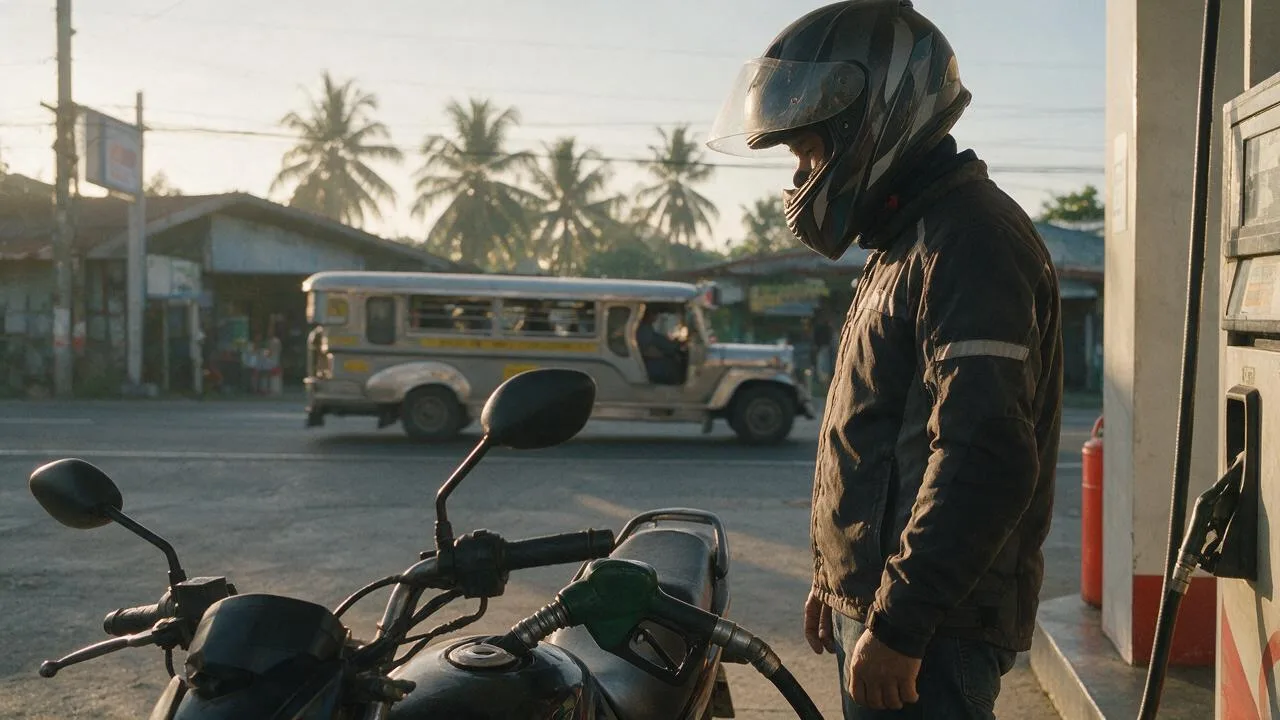
The most accurate way to compute km/L is the full-tank method: fill up, reset the trip meter, ride normally, fill up again, and divide the kilometers by the liters you added.
 AI-generated image
Step by step:
- Fill the tank until the pump clicks off. Use the same pump, or at least the same station, if you can.
- Reset the trip meter to zero (or write down the odometer).
- Ride your usual mix for at least one full tank. Commutes, a weekend ride, whatever you normally do.
- Fill up again to the same level and note the liters.
- Divide the kilometers on the trip meter by the liters you just added.
Example: 312 km ÷ 7.8 liters = 40 km/L.
Do this three times and average the results. One tank can be skewed by a single traffic jam on EDSA or a fast run on SLEX. If your bike has a fuel consumption readout on the dash, compare it with your full-tank number; some readouts lean optimistic.
Why your km/L is lower than the spec sheet
Manufacturer figures are measured under controlled conditions, so treat them as a best case. Real numbers drop with:
- Stop-and-go traffic. Idling and short bursts of throttle burn fuel with no distance to show for it.
- Climbs. Mountain roads like Marcos Highway or the zigzag roads of the Cordillera ask for more throttle and lower gears.
- Speed. Wind resistance rises sharply above highway cruising speed, especially on naked bikes.
- Load. A passenger, top box and saddlebags all cost you km/L.
- Neglected maintenance. Underinflated tires, a dirty air filter, worn spark plug or a dry, tight chain all add drag or waste fuel. Our motorcycle maintenance schedule covers what to check and when.
Motorcycle fuel cost calculator: a quick table in liters
A simple way to estimate is to know how many liters your bike needs per 100 km, then scale it to your ride. Pump prices move every week, so we keep this table in liters; multiply by today's price at the pump.
| Your real km/L | Liters per 100 km | Liters for a 300 km ride | |---|---|---| | 60 km/L | 1.7 L | 5.0 L | | 45 km/L | 2.2 L | 6.7 L | | 35 km/L | 2.9 L | 8.6 L | | 25 km/L | 4.0 L | 12.0 L | | 18 km/L | 5.6 L | 16.7 L |
Small scooters and commuter bikes usually sit near the top of the table. Larger-displacement big bikes, especially when ridden hard, tend toward the bottom. Your own full-tank test tells you which row is yours.
To turn liters into pesos, multiply by the current price for the fuel grade your bike uses. See this week's pump prices before you set your ride budget.
How much gas do you need for a long ride?
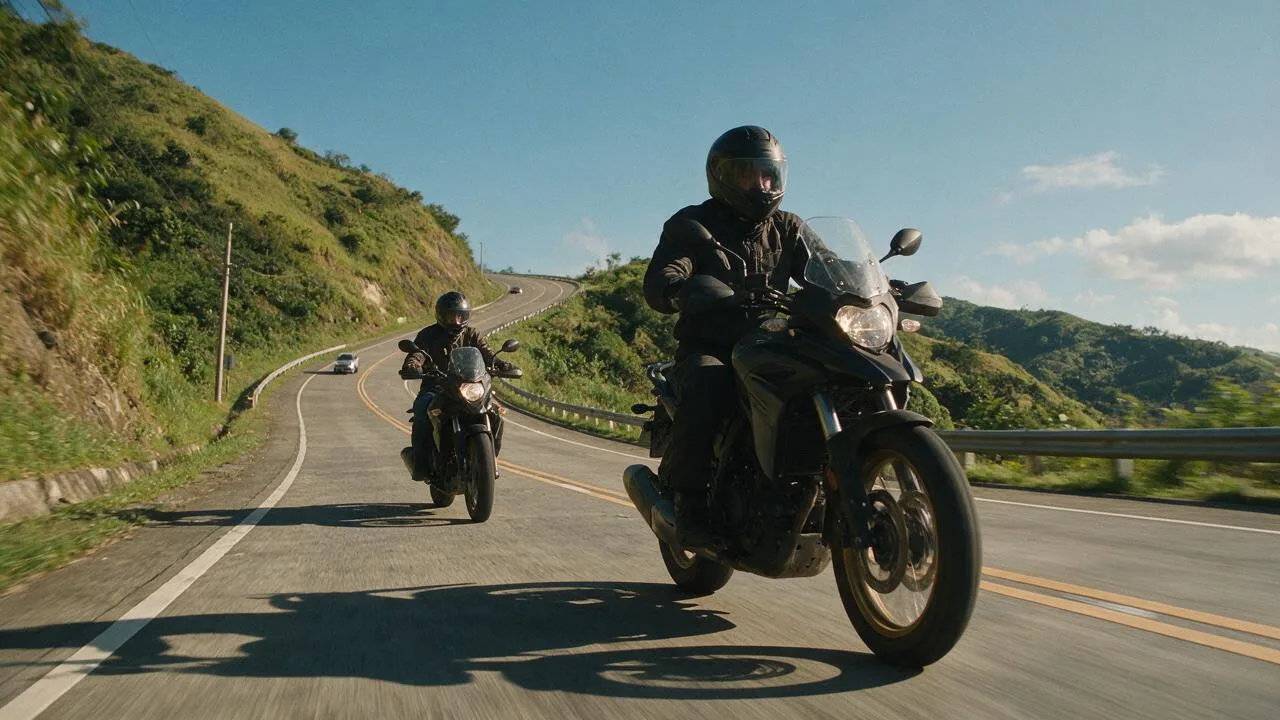
You need your total ride distance divided by your real km/L, plus a buffer, and you also need to know how far one tank takes you so you can plan fuel stops.
 AI-generated image
Work out your tank range first:
- Tank capacity in liters × your real km/L = full-tank range.
- Plan to refuel at about 70 percent of that range, not when the light comes on.
A bike with a small tank can need several stops on a day that a touring bike covers on one tank. On highways around Metro Manila, stations are frequent. On mountain roads and remote coastal stretches, they are not, and some small stations close early or run out of a fuel grade. Fill up in the last big town before a climb or a long empty stretch.
Sample ride budgets near Manila
Here is how the computation looks for typical day rides in CALABARZON. Measure your own route distance in a maps app, since the exact kilometers depend on where you start.
- Tagaytay loop, Cavite. Mostly highway with traffic in towns. A ride to the Tagaytay Ridge Viewpoint is a common first long ride, so use your normal highway km/L with a 10 percent buffer.
- Marcos Highway, Rizal to Quezon. Long climbs and descents. Use a 20 percent buffer for a run to the KM90 Laguna-Quezon boundary on Marcos Highway and fill up before the climb.
- Laguna lake loop. Mixed provincial roads. Add a stop at the Pililla Wind Farm in Rizal or a ride to Caliraya Lake in Laguna and count the side trips in your total distance.
For more ideas with distances you can plug into the formula, browse more motorcycle destinations in Luzon or our guide on how to find ride spots near Manila.
How do you split gas cost on a group ride or with a passenger?
The fair way is to split by liters actually used, not by headcount. Each bike in a group ride burns its own fuel, so riders usually pay for their own tanks and split only shared costs like toll fees or a support vehicle.
With a passenger (angkas), the fuel cost is one bill for one bike. Compute the whole trip with the formula, add the buffer for the extra weight, and split it however the two of you agree. Be honest about the buffer: two-up riding on hills uses noticeably more fuel than solo riding.
Planning the Bonifacio Day long weekend ride
Bonifacio Day falls on Monday, November 30, 2026, a regular holiday, which gives riders a three-day weekend from Saturday, November 28. That is a good time to do the math before you leave instead of guessing at the pump.
For a long weekend ride:
- Compute each day's distance separately; day two of a tour often has the most climbing.
- Expect heavier traffic leaving and returning to Metro Manila, which lowers your km/L. Add an extra 10 percent on those legs.
- Fill up the night before. Stations on main exits can get long lines on holiday mornings.
- Check PAGASA for weather the day before and the morning you leave. Late-season rain can still hit parts of Luzon in November, and riding in rain with full gear and a lighter throttle changes your consumption too.
Ways to lower your motorcycle gas cost
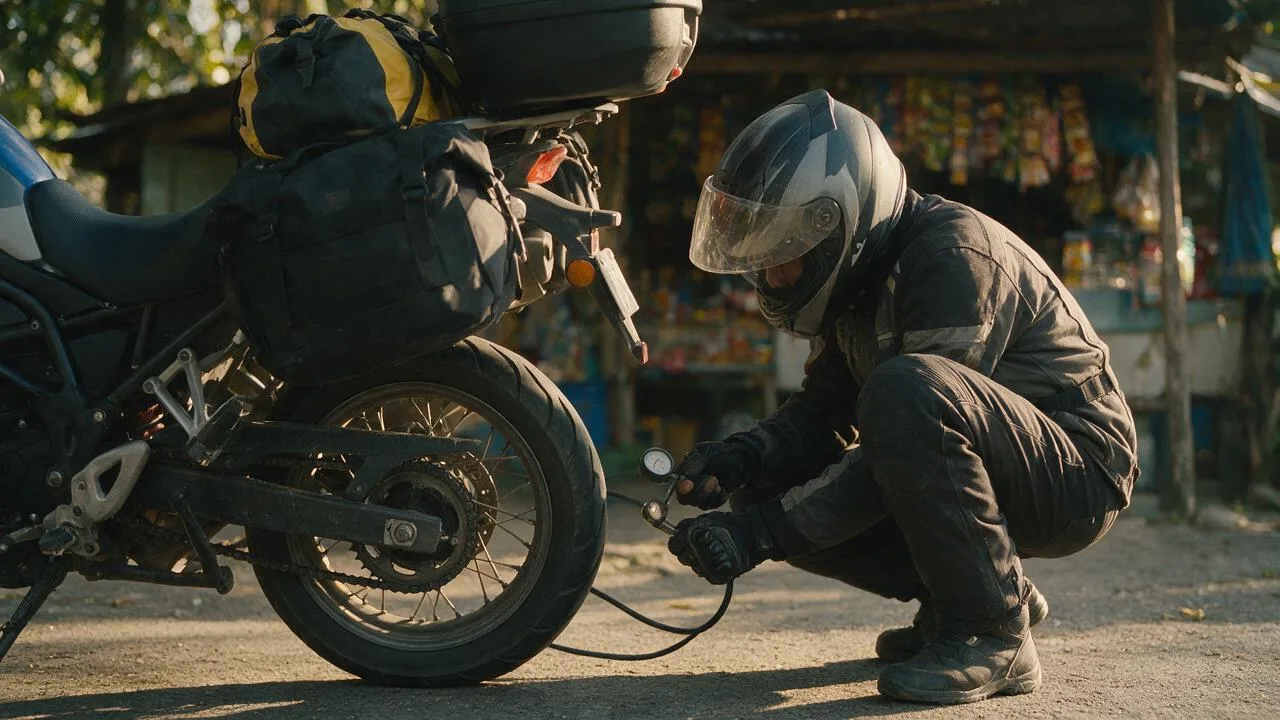
You lower fuel cost mostly through riding habits and maintenance, not additives or gadgets.
 AI-generated image
- Keep tires at the pressure in your owner's manual. Check them cold, before the ride.
- Smooth throttle. Roll on gradually and look far ahead so you brake less.
- Hold a steady cruising speed. Fuel use climbs fast at higher speeds.
- Don't idle for long. If you're stopped for several minutes, switch off.
- Lighten the load. Leave the extra gear you never use at home.
- Stay on schedule with PMS. Clean air filter, correct oil, adjusted chain.
- Use the fuel grade your manual calls for. Higher octane than required doesn't add km/L by itself.
Make motorcycle gas cost computation a habit
Motorcycle gas cost computation gets easier and more accurate every time you log a fill-up. Write down the odometer and liters at each stop, update your real km/L every month, and you'll be able to budget any weekend ride or long ride in Luzon, Visayas or Mindanao in under a minute. If you log your rides in Waypoint, each one also counts toward Passport stamps for the provinces you pass through.